
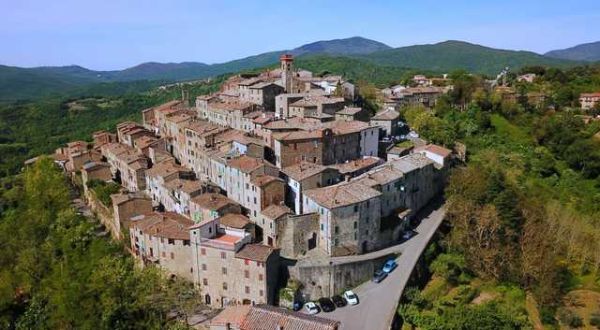
Nestled in unspoilt countryside, on one of the hills rising from the Merse river valley towards the Metalliferous Hills, surrounded by dense oak forests, Chiusdino stands out with its stone and brick houses and narrow, quiet streets that transport visitors to an atmosphere suspended in time.
The area, inhabited since Etruscan times, underwent significant development starting in the Middle Ages, when the town was founded as a castle within the large diocese of Volterra, on the border with the domains of the Counts of Gherardesca. The oldest city walls are still visible today, enclosing the Portino district at the top of the hill.
Immediately behind the walls, which also include the Propositura di San Michele Arcangelo, the birthplace of San Galgano was built, while the late Romanesque church of San Martino was located just outside the walls, near a gate that is still preserved today.
From the second half of the 12th century, Siena, which was expanding rapidly towards the Metalliferous Hills with their silver mines and towards the sea, began the process of annexing Chiusdino, which was completed in 1215 with the castle’s oath of allegiance to the Sienese Republic.
The development of Chiusdino, which had led to the construction of a second wall to enclose the villages that had sprung up outside the original castle, came to a halt with the plague of 1348, which was followed by a severe demographic and economic crisis.
A new and decisive phase of recovery linked to the development of agricultural activities, forestry and, above all, the reactivation of mining activities began in the second half of the 18th century and continued throughout the 19th century and much of the 20th century. The closure of the Campiano mine near Boccheggiano, in the municipality of Montieri, which provided work for the entire area and dated back to the 1880s, combined with the crisis in agriculture, ushered in a period of sharp demographic decline which, especially in the Metalliferous Hills area, led to the depopulation of entire villages.
Today, thanks to new opportunities arising from the exploitation of geothermal resources, the revival of forest-related activities, which for a long time contributed to the survival of the community, and the new challenge that, through significant investments in cultural heritage, is opening the doors to tourism, especially slow and sustainable tourism, Chiusdino is pursuing new paths aimed at enhancing its natural and cultural heritage.
Visiting Chiusdino means immersing yourself in nature and art, rediscovering relationships and rhythms of life that seem forgotten, losing yourself in the narrow streets, or finding yourself touching the clouds as you climb the streets of Portino towards the sky.

